

Security Badges, partnership logos
Comprehensive Protection for Websites – Uncompromised Website Security
Hosting Garage simplifies enterprise-grade web security services, delivering premium, fully managed protection without the complex overhead.
Why Web Security is More Important Than Ever
Website security is critical, as cyberattacks now prioritize operational disruption, AI-powered extortion, and long-term reputational damage over simple data theft.
AI Has Lowered the Barrier to Entry: Attackers use AI to automate phishing, identify vulnerabilities, and craft sophisticated malware, allowing them to launch attacks.
Ransomware-as-a-Service (RaaS): Ransomware is readily rented online, making it accessible to more criminals and increasing the overall volume of attacks.
Third-Party Vulnerabilities: Hackers identify security weaknesses in external vendors, software, or service providers that can be exploited to breach a connected organization’s data or systems.
Rise of Zero-Day Vulnerabilities: Attacks often occur before patches are released, exploiting weaknesses in software, especially VPNs and firewalls.
Regulatory Penalties & Data Privacy Laws: New laws (e.g., India’s DPDPA) impose massive fines for non-compliance, making poor security a legal liability.
Brand Trust and SEO Penalty: Failing to secure your site with HTTPS can lead to Google flagging it as unsafe, resulting in a potential 95% drop in organic traffic.
Website Attack Statistics (2025-2026 trends)
- Cyberattacks have increased by nearly 40% globally in 2026.
- Phishing continues to be the top breach vector, accounting for 18% of cases
- AI is now utilized in over 80% of phishing campaigns.
- Shadow AI increased India’s 2025 breach costs by ₹17.9 million.
- Ransomware is present in 44% of reviewed breaches
- Research/transportation had India’s highest 2025 breach costs (₹289M+), says IBM
Common Security Threats websites face today
| Threat | What Happens |
|---|---|
| Malware Injection | Attackers insert malicious code |
| Brute Force Attacks | Bots try thousands of passwords |
| SQL Injection | Attackers manipulate databases |
| DDoS Attacks | Traffic floods crash websites |
| Phishing Redirection | Visitors get redirected to fake pages |
Complete Website Protection Requires Multiple Security Layers
We adopt a ‘never trust, always verify’ approach to website security.
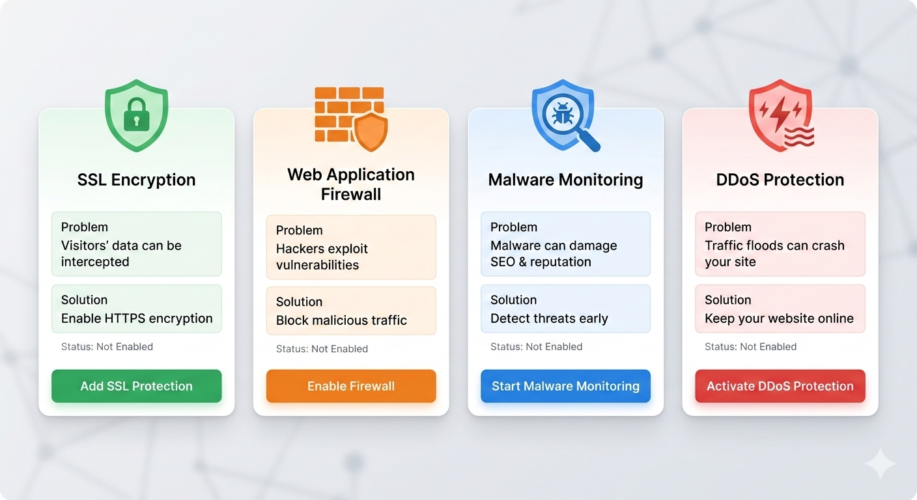
Our Managed Web Protection Stack
We build layered protection around your website. Select the necessary services to secure your website.
SSL Certificate Management
- HTTPS setup & configuration
- Renewal management
- Mixed content fixing
- Proper server installation
Get Started
Web Application Firewall (WAF)
- SQL injection protection
- XSS attack blocking
- Bot filtering
- Custom rule tuning per website
Get Started
DDoS Mitigation Setup
- Traffic filtering
- Rate limiting configuration
- Attack surface reduction
- DNS-level hardening
Get Started
Malware Scanning & Monitoring
- Scheduled malware scans
- Blacklist monitoring
- Suspicious file detection
- Cleanup guidance
Get Started
Most Websites are under-protected – Web Security is not Optional, it’s essential.
Over 84% of websites are vulnerable, primarily due to poor maintenance and the misconception that only large firms are targeted.
- Outdated Software & Plugins: Platforms like WordPress do not keep CMS, plugins, and themes updated, leaving known, easily exploitable vulnerabilities.
- The Small Business Misconception: Many owners believe they are too small to be targeted, yet 41% of small businesses suffered cyberattacks in 2023.
- Set-and-Forget Mentality: Website security requires continuous monitoring, yet many treat it as a one-time setup rather than an ongoing maintenance task.
- Lack of Proper Security Layers: Missing SSL/TLS Certificates (HTTPS), no Web Application Firewall (WAF), and weak password policies leave the door open.
- Complex Third-Party Dependencies: Modern sites rely heavily on external plugins and APIs, which can introduce security gaps if not properly vetted.
Is Your Website Fully Protected?
Take a Test to understand the web protection offered by your current hosting vendor. Even if one of these layers is missing, your website could be exposed to avoidable security risks.
| Security Layer | Protected? |
|---|---|
| SSL encryption (Not free SSL like Let’s Encrypt) | ❓ |
| Firewall protection (WAF) | ❓ |
| Malware monitoring (Is your server malware protected?) | ❓ |
| Server-Level DDoS Protection (Not DC level) | ❓ |
Most websites do not follow Zero Trust principles, leaving them vulnerable to automated attacks. Know your website security score to identify potential risks.
Check Your Website Security Score
Enter your website and discover potential security gaps.
[ Website URL ]
[ Email ]
Check My Website Score
Free audit report delivered within 24 hours
The Security Gap with Top Hosting Companies
Hosting typically secures server infrastructure (firewalls, monitoring), leaving application-layer security (malware scanning, SSL, WAF, patching) to the customer. Websites may still be exposed to:
- login brute-force attacks
- malicious bots
- plugin vulnerabilities
- malware infections
This means website owners must buy and configure:
- SSL certificates
- Firewall rules
- Malware scanning
- Bot protection
- DDoS mitigation
Critical Security Actions for 2025–2026
Adopt Zero Trust Architecture: “Never trust, always verify” all users and devices.
Implement Phishing-Resistant MFA: Use biometrics or hardware tokens, not just SMS codes.
Patch Management: Patch critical vulnerabilities within 15 days.
Automated Backups: Ensure daily, off-site backups to recover from ransomware.
WAF Deployment: Use a Web Application Firewall (WAF) to block malicious traffic before it hits the server.
Employee Training: Train staff on spotting AI-driven phishing and deepfakes.
Why Choose Hosting Garage Web Security Services?
Platforms like Cloudflare, Sucuri, Malcare may offer you powerful tools, but It Is self-managed, and they expect you to:
- Set firewall rules
- Tune bot filters
- Monitor traffic logs
- Respond to attacks
We don’t just sell security tools. We help you understand, fix, and manage your website security.
| Feature | Cloudflare Direct | Hosting Garage |
|---|---|---|
| Setup | Self-configured | Done for you |
| Firewall Rules | Manual | Optimized |
| Monitoring | DIY | Assisted |
| Issue Resolution | Self-managed | Supported |
| Security Strategy | Not included | Included |
Security Insights from Hosting Garage
Many websites are vulnerable not because security tools are unavailable, but because they are misconfigured or not monitored.
Security tools don’t protect your website. Proper configuration and monitoring do.
Fully Managed Hosting with Integrated WAF, Malware Scanning, and Auto-Backups
Complete Server Management with Malware Cleaning, WAF, Backups & Uptime Monitoring in One Plan.
Managed Hosting services with Zero Trust Security & Advanced Threat Protection, starting at 1299/month
Web Application Security Framework
- Implement Encryption (SSL/TLS): Install an SSL certificate to encrypt data between the browser and server (HTTPS).
- Keep Software Updated: Regularly update the Content Management System (CMS), themes, and plugins to patch vulnerabilities.
- Use a Web Application Firewall (WAF): Deploy a Cloudflare WAF to block malicious traffic before it reaches the website.
- Access Control and Authentication: Use strong, unique passwords for all accounts. Implement Multi-Factor Authentication (MFA) for the admin panel.
- Regular Backups: Perform automatic daily or weekly backups. Store backups in a separate, secure location (cloud storage) for restoration.
- Security Scanning & Monitoring: Utilize plugins to scan for malware, file changes, and unauthorized access attempts.
- Secure Web Hosting: Choose the best hosting that offers security features like DDoS protection.
Security Tools We Work With
Cloudflare for WAF and DDoS protection
Malcare for WordPress malware cleaning
Web Security Services F&Q
What are web security services?
Web security services protect websites from cyber threats like malware, DDoS attacks, hacking attempts, and data breaches. They include SSL certificates, firewalls, malware scanning, and monitoring.
Do I need web security if I already have hosting?
Yes. Hosting protects server infrastructure, but web security protects your website at the application level. Firewall configuration, malware scanning, and DDoS mitigation are essential for full protection.
What is a Web Application Firewall (WAF)?
A Web Application Firewall filters and blocks malicious traffic before it reaches your website. It protects against SQL injection, cross-site scripting (XSS), and bot attacks.
How is Hosting Garage different from large providers?
Unlike large platforms that offer self-serve tools, Hosting Garage configures, monitors, and manages your website security, providing hands-on support and simplified pricing.
How much do managed web security services cost?
Managed web security plans start at ₹1,499 per month, depending on your website’s size, traffic, and protection requirements.
How often should a website security audit be done?
Website security audits should ideally be conducted quarterly to proactively identify vulnerabilities, with a bare minimum of once a year for low-risk sites. High-risk sites, such as e-commerce or financial services, should be audited at least every 3–6 months.
How does malware scanning work?
Malware scanning identifies threats by analyzing files, programs, and system behavior using signature-based detection, heuristics, and behavioral monitoring for detecting malicious code.
Don’t Wait Until Your Website Gets Hacked
Security is invisible until it fails. Protect your website before it becomes a problem